
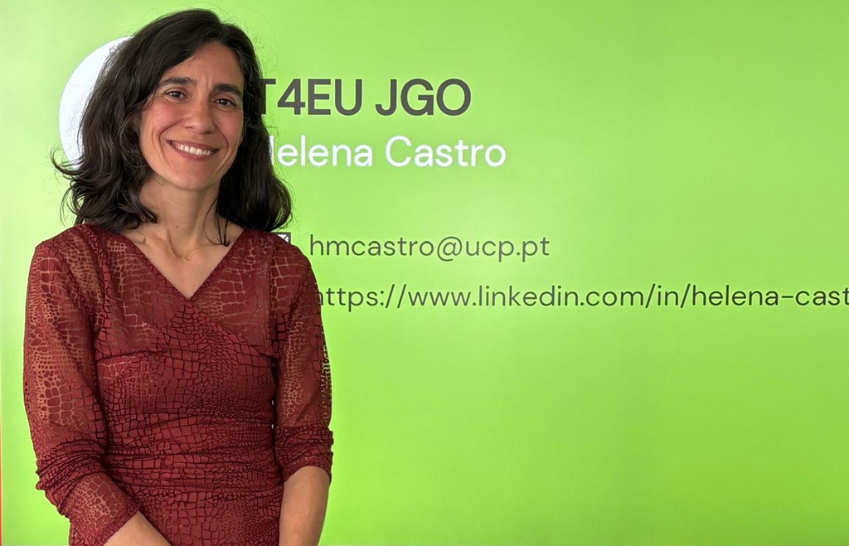
Earlier this month, the University of Trieste welcomed Helena Maria Castro, Coordinator of the T4EU Joint Grants Office based in Porto.
As part of her visit, she held a series of meetings and training sessions with administrative staff and researchers, focusing on opportunities for attracting European projects, particularly within the Horizon Europe and Erasmus+ programmes. The sessions offered valuable insights into European funding strategies and the development of international collaborative projects.
We asked her what a Grant Officer actually does and which skills are most important today in the world of European funding.
Read the interview ↓
What exactly does the T4EU Joint Grants Office do?
The T4EU Joint Grants Office (JGO) is a team of 12 funding liaison officers: one from each T4EU partner university, plus the JGO Manager, who acts as the Alliance-level coordinator.
The JGO supports T4EU in identifying funding opportunities for joint education and R&I initiatives, building cross-university consortia, developing competitive proposals, and strengthening the Alliance’s capacity to compete in the European funding arena through dedicated capacitation of researchers and staff.
The JGO mission goes beyond attracting funds, though: by reinforcing collaboration at project-level, the T4EU JGO acts as a catalyst for building stronger and more robust connections within the Alliance.
What skills are needed today to develop effective European projects?
Skills are evolving alongside the technological environment in which we work nowadays. AI agents already outperform humans in most ‘operational’ tasks, like desk research, summarizing information, drafting texts, structuring ideas. This makes the human role more ‘strategic’ than ever.
We are no longer alone in the drivers’ seat: AI agents have become very efficient co-pilots. We must know how to use them intelligently, critically, and responsibly to win the very competitive European funding race.
Critical thinking is key: asking the right questions, designing meaningful prompts, assessing AI-generated outputs, and ensuring that the final project remains accurate and coherent. Other human skills also remain critical and irreplaceable, namely our ability to connect with and listen to people, and to use creativity to develop proposals that are passionate, authentic, and marked by a unique identity.
What added value does a European alliance such as T4EU bring to project design?
European alliances bring added value to project design by offering frameworks for transnational cooperation among universities that work together and have built a strong basis of trust that strengthens consortia credibility.
T4EU, in particular, brings additional value through its ‘unique’ diversity. With universities across 11 European countries, T4EU brings together different regional contexts and societal challenges. It also covers a broad range of disciplines, from exact sciences and social sciences to humanities and the arts.
This diversity is especially valuable at consortium design level. When a project idea needs additional expertise, complementary profiles or new perspectives, the T4EU community can be a first space to look for potential partners.