Impurities and polarons in quantum neutral matter
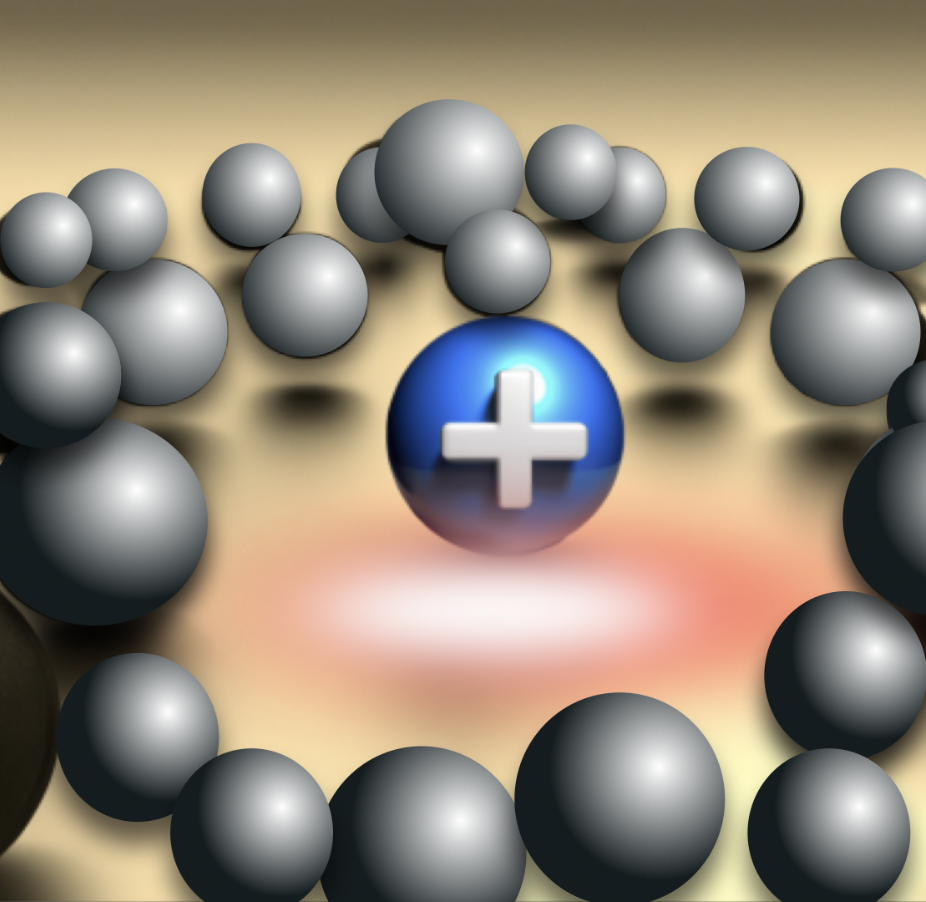
Research on neutral impurities in quantum gases focuses on studying the behavior and effects of non-charged particles (neutral impurities) within ultra-cold atomic or molecular gases. These impurities are typically introduced into the quantum gas, and their interactions with the surrounding atoms or molecules are investigated. The study of neutral impurities in quantum gases has provided valuable insights into various physical phenomena, including quantum dynamics, quantum phase transitions, and many-body physics. This research is significant for understanding fundamental aspects of quantum systems and has potential applications in quantum computing, quantum simulation, and precision measurements.
Selected Publications
F. Grusdt, N. Mostaan, E. Demler and LAPA. REVIEW. Impurities and polarons in bosonic quantum gases: a review on recent progress (2025).
J. Levinsen, LAPA et.al. PRL (Edit. Sug) 127, 033401 (2021)
LAPA. PRA 103, 033323 (2021).
LAPA, N. B. Jørgensen, et.al, PRA 99. 063607 (2019).
A. Camacho-Guardian, LAPA, et.al, PRL. 121, 013401 (2018)
LAPA and S. Giorgini. PRA 92. 033612 (2015).
Exotic states of the matter
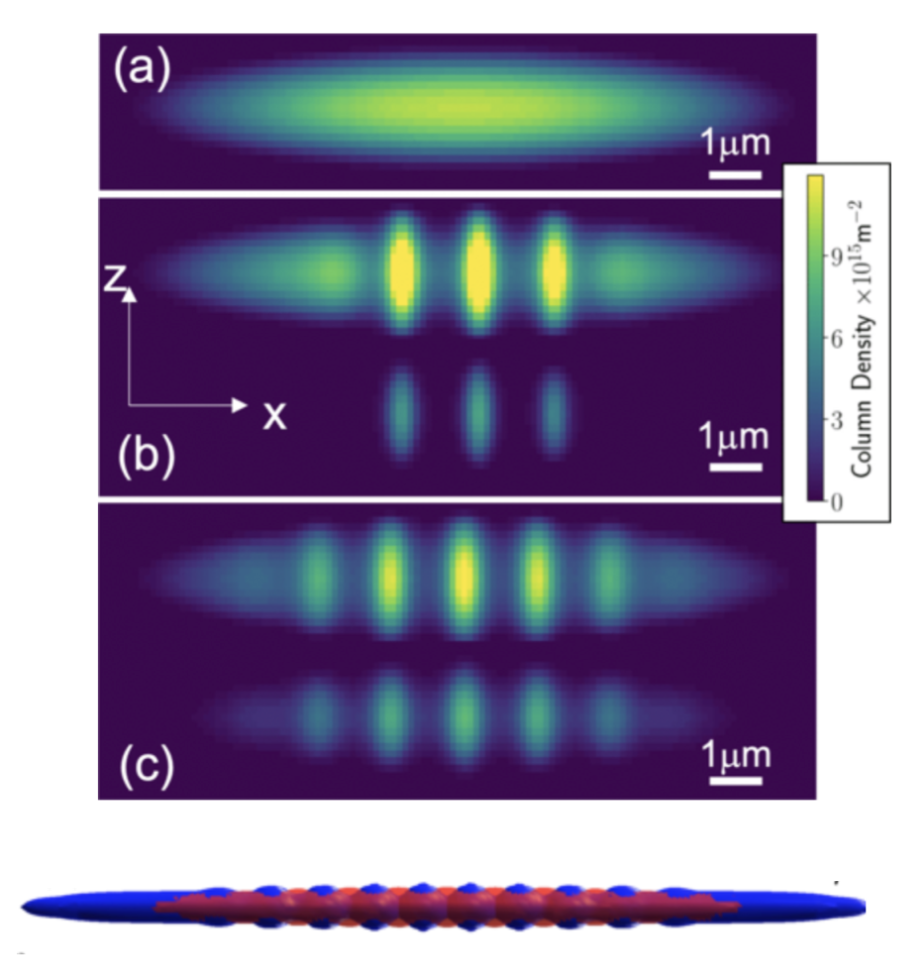
Quantum droplets and superfluid solids, also known as supersolids, are fascinating phenomena observed in ultracold quantum gases. Quantum droplets are stable, self-bound entities formed by interactions between particles in a gas. Unlike traditional droplets, which are held together by surface tension, quantum droplets arise due to quantum fluctuations and repulsive interparticle interactions. These droplets exhibit unique properties such as density profiles that are spatially localized, effectively behaving as a macroscopic quantum object. On the other hand, supersolids are intriguing states of matter that combine characteristics of both solids and superfluids. In supersolids, atoms arrange in a crystal-like lattice while simultaneously flowing as a superfluid. These exotic states emerge when the repulsive interactions between atoms are balanced with quantum fluctuations, resulting in simultaneous long-range order and coherence. The study of quantum droplets and supersolids in ultracold quantum gases offers valuable insights into the fundamental nature of matter and opens up possibilities for exploring novel quantum phenomena and potential applications in quantum technologies.
Selected Publications
T. Bland, E. Poli, LAPA, et.al., PRA 106 053322 (2022)
D. Edler, LAPA, et.al. PRR 4, 033017 (2022)
R. Bisset, LAPA, and L. Santos. PRL 126, 025301 (2021)
D. Scheiermann, LAPA, et.al.. arXiv:2202.08259 (2022)
Atom-ion quantum hybrid systems
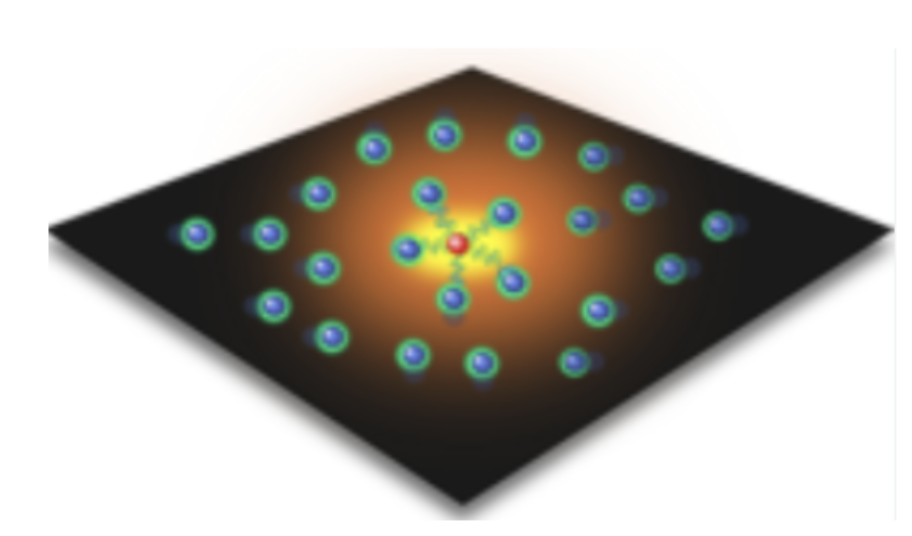
Atom-ion systems in ultracold gases provide a unique platform for studying a wide range of intriguing phenomena in quantum physics. One fascinating aspect is the formation of ion Bose polaron and ion Fermi polaron complexes. In an ion Bose polaron, an impurity ion interacts with a surrounding gas of bosonic atoms. The strong attractive interaction between the ion and the bosons leads to the dressing of the ion by the bosonic cloud, effectively forming a quasiparticle. This dressing modifies the properties of the ion, such as its mass and spectral features, creating a novel hybrid state. Similarly, in an ion Fermi polaron, the impurity ion interacts with a gas of fermionic atoms. Due to the Pauli exclusion principle, the dressing effect is different compared to the Bose polaron case, resulting in distinct behaviors and characteristics. These atom-ion systems with ultracold gases offer rich opportunities for studying the physics of polaron formation, many-body interactions, and quantum impurity effects, contributing to our understanding of strongly correlated systems and opening up avenues for potential applications in quantum simulation and information processing.
Selected Publications
LAPA. Nat Rev Phys, 4, 214 (2022).
G.E. Astrakharchik and LAPA, et.al, arXiv:2206.03476v1(2022)
R. Pessoa, S. A. Vitiello, and LAPA Phys. Rev. Lett. 133, 233002 – 2024.
G. E. A and LAPA, et.al. Comm Phys. (Nature) 4, 94 (2021)
Quantum Many body Physics in Condensed Matter
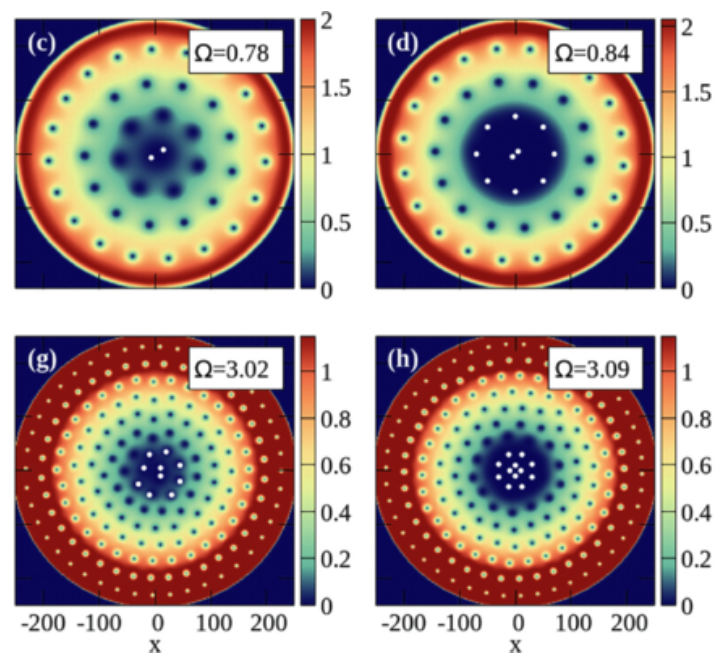
Quantum phenomena occurring in solid-state systems involve the collective effects of electrons, excitons, and other quasi-particles within condensed matter. Solid-state systems offer a flexible platform for investigating quantum phenomena including coherence, entanglement, and many body interactions in well-defined conditions. For example, such systems as exciton-polaritons, superconducting circuits, and stacked structures allow researchers to study dynamics and quantum phases out of equilibrium. It is the strong interaction effects, lower dimensionality, and controllability that make solid-state platforms an excellent choice to study quantum physics fundamentals and develop quantum technologies.
Selected Publications
S. Conti, A. Chaves, LAPA, et.al. PRB 112, 184514 (2025).
G. A. Domínguez-Castro, L. Santos, LAPA, et.al. PRB 113, 035111 (2026) (Editors' Suggestion).