T4EU Common European Heritage Week 2026

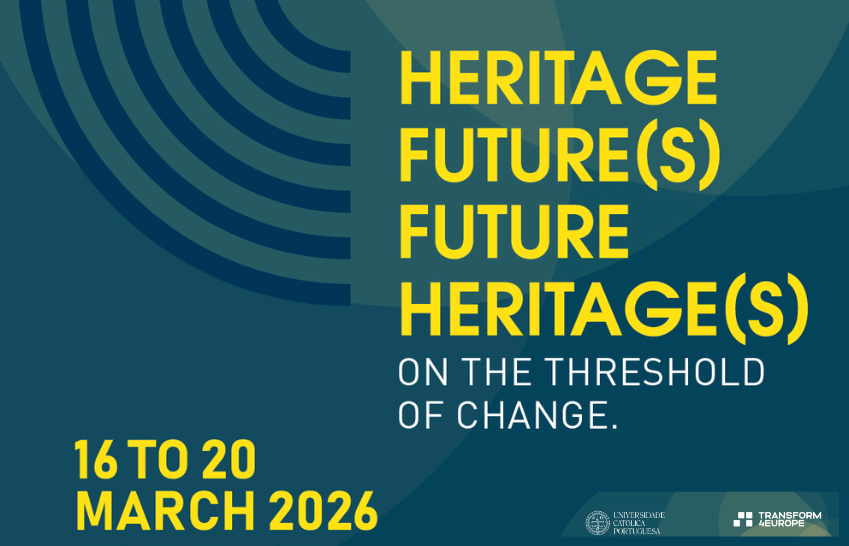
Porto, 16–20 March 2026

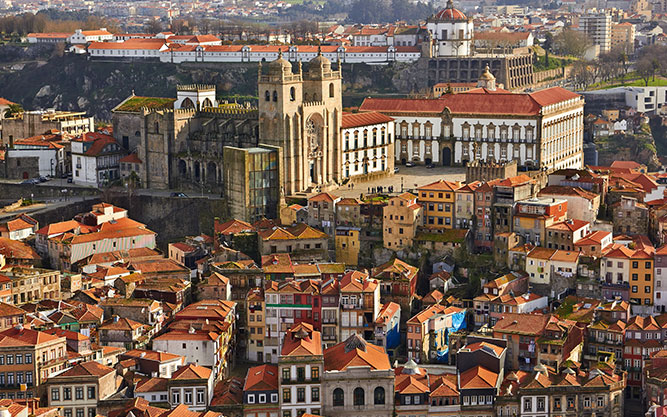
The T4EU Common European Heritage Week 2026 will take place in Porto (Portugal) from 16 to 20 March 2026, hosted by the Universidade Católica Portuguesa.

The week will bring together researchers, professionals, students, and cultural practitioners from across the Transform4Europe alliance to reflect on the future of cultural heritage in a time of profound ecological, technological, and social change.

The overarching theme of the week is Heritage Future(s) / Future Heritage(s): On the Threshold of Change

The programme includes conferences, workshops, public events, exhibitions, and site visits, offering multiple perspectives on heritage conservation, sustainability, and innovation.

Programme Highlights

The Museu das Convergências is a new cultural facility in Porto, dedicated to transculturality in art and connected art histories. The visit will conclude with a conversation between Rui Oliveira Lopes (Director of the Museum) and Roberta Altin, moderated by Laura Castro (UCP).

The programme will also feature:

  • “Invisible Garden” Exhibition – a T4EU common culture travelling exhibition
  • Additional cultural activities and surprises throughout the week

Results of the selection process for the T4EU Week in Kaunas

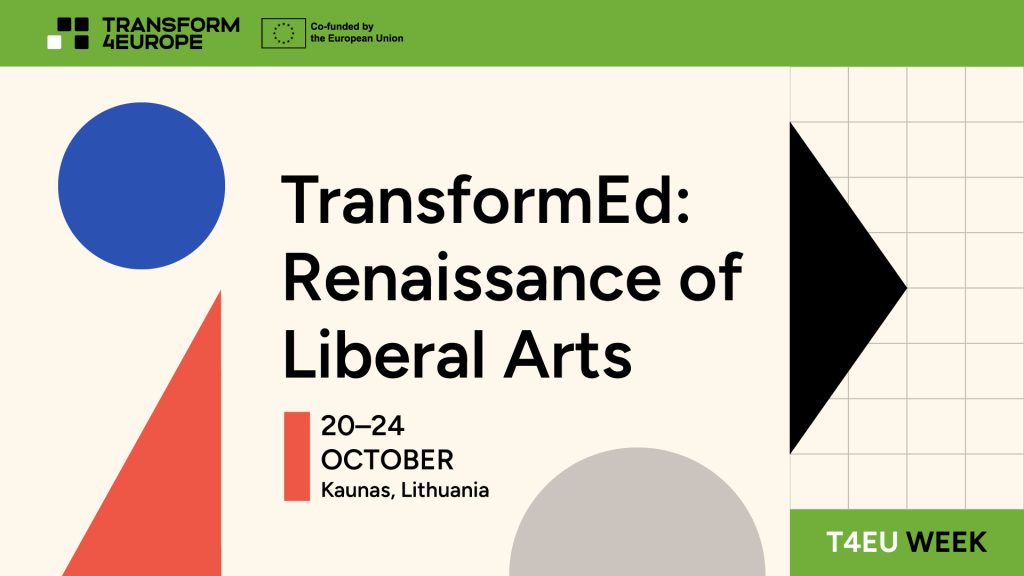
We are pleased to announce the results of the selection process for participation in the T4EU Week “TransformEd: Renaissance of Liberal Arts”, which will take place in Kaunas from 20 to 24 October 2025.

The following students have been selected:

Bachelor’s Degree students
EC0104376
SM2001998
SP0203490
EC0104183
SM5102088
EC1200941

Master’s Degree students
SP5400501
LE6300220
GI0104434
GI0104189
IN1600563
ME0302171

PhD candidates
DR0400012

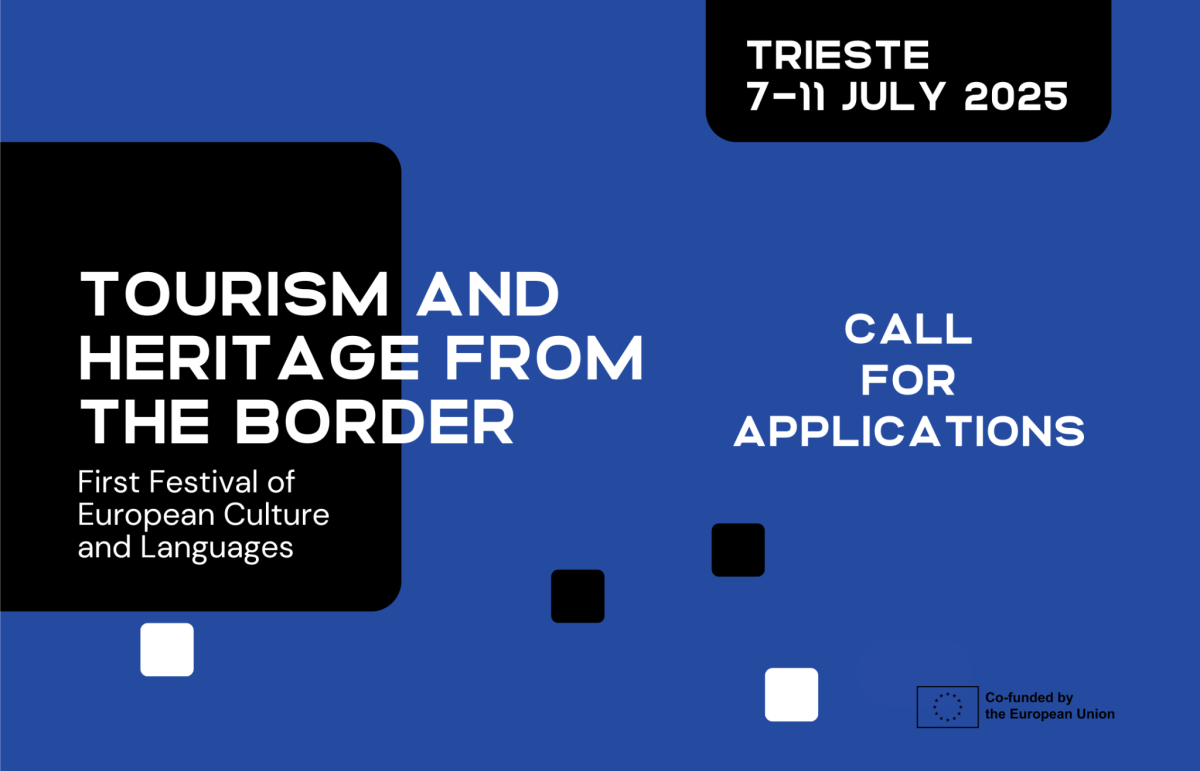
First Festival of European Culture and Languages

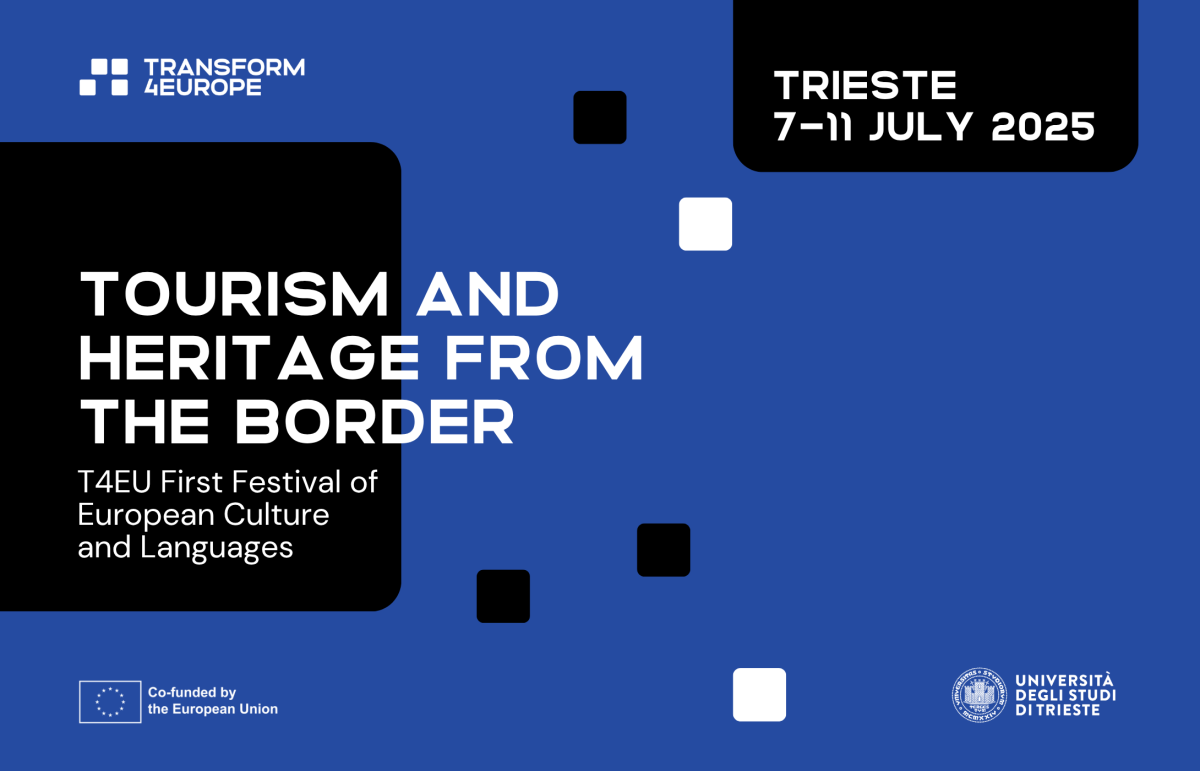
Tourism and Heritage from the Border – 7–11 July 2025 | University of Trieste, Italy

Tourism is a powerful force in shaping Europe’s cultural and economic landscape, but it also raises critical issues: overtourism, simplified narratives, and the erasure of historical complexity. These effects are particularly evident in border cities where rich, layered identities and diverse memories are often reduced to stories that are easier to market.

The Festival of European Culture and Languages, organised within the Transform4Europe University Alliance, takes on these questions through an immersive and critical learning experience for students and researchers coming from across Europe.

Trieste —an emblematic border city with a complex past— becomes the stage for this open-air laboratory on heritage. Designed as a Blended Intensive Programme (BIP), the Festival combines theory and practice through several lectures, interdisciplinary workshops, urban explorations, and creative performances. The aim is to challenge standardised heritage representations and foster new reflections on identity, memory, and cultural sustainability in a changing Europe.

Programme Highlights:

25th June – An online kick-off meeting for the participants, with an introduction to the goals and structure of the week. The session includes two lectures on tourism intertwined with mobility and memory, led by Professors Roberta Altin and Alessandro Carrieri.

7th July – The official launch of the Festival at the University of Trieste, followed by a guided tour of the city led by Professors Roberta Altin, Tullia Catalan, Giuseppe Grimaldi and Alessandro Carrieri. Participants will critically examine Trieste’s tourist image through the lenses of anthropology, history, and heritage studies.

8th July – A full day dedicated to the theme of “heritage of overtourism.” Coordinated by Roberta Altin and Giuseppe Grimaldi, the day opens with a roundtable discussion featuring scholars from various disciplines. This is followed by a workshop on mapping border tourism led by Stefano Mastromarino. The day ends with the screening of Abito di Confini (2025), a film by Opher Thomson exploring the connections between tourism and migration — free and open to the public event.

9th July – A deep dive into memory tourism, coordinated by Professors Tullia Catalan and Alessandro Carrieri. The group will take a critical excursion to historical and natural heritage sites, focusing on contested, forgotten, and reinterpreted memories and the reshaping of the spaces that host them.

10th July – A day focused on multilingualism, a foundational element of Trieste’s identity. Organised by Federica Fragapane of the School for Interpreters and Translators, the day begins with a lecture by Professor Piergiorgio Trevisan on the legacy of multilingualism in Trieste, followed by hands-on language workshops.

11th JulyFinal presentations: students will share their projects, developed collaboratively during the week. The day concludes with the announcement of the winning initiatives for the T4EU Common Cultural Activities, a cross-alliance initiative dedicated to heritage collaboration among Transform4Europe partner universities.

The Festival — which will also be enriched by the simultaneous running of the “First T4EU Sustainable Heritage Student Competition”, focusing on the relationship between heritage, the environment, and generational awareness — will serve as an opportunity to raise participants’ awareness of key contemporary issues.

In addition to involving students, researchers, and professors from the University of Trieste and various European universities, selected events from the Festival and the Student Competition will also be open to the general public. These events, free and open-access, will be held in English and include:

  • Tuesday, July 8, 9:30 AM, Androna Baciocchi (Room A) – Perspectives on Overtouristification and Heritage Roundtable with professors, researchers, and experts from UniTS, OGS, SISSA, ECAN, and UCL.
  • Tuesday, July 8, 6:00 PM, Cinema Ariston Abito di Confini (2025) by Opher Thomson Film screening followed by a discussion with the director.
  • Wednesday, July 9, 2:00 PM, Androna Baciocchi (Room A) – Climate Change across Space and Time Roundtable with professors, researchers, and experts from UniTS, OGS, AMP Miramare, and gECO.
  • Thursday, July 10, 9:30 AM, Androna Baciocchi (Room A) – Crossroads of Voices: Multilingualism in a Global Context and the Unique Case of Trieste Lecture by Prof. Piergiorgio Trevisan, UniTS.
  • Friday, July 11, 9:30 AM, Androna Baciocchi (Room A) – Work Group Projects Student Presentations Presentation of the projects developed by students during the Festival’s working week.
Apply now to join the T4EU Week in Kaunas

Don’t miss the chance to participate in one of the most exciting events organised by the T4EU Alliance

Vytautas Magnus University invites BA, MA and PhD students to participate in the sixth edition of the T4EU Week, under the topic: “TransformEd: Renaissance of Liberal Arts”.

Five days, from 20th to 24th October 2025, will be filled with an attractive offer of classes and social events.

The University of Trieste will select 6 BA, 6 MA and 3 PhD students to take part in one of the most significant events of our University Alliance.

Learn more about the programme and apply.

IMPORTANT!  Before you attend the selected course, remember to inform your “Coordinatore del Corso di Studi” and the “Segreteria didattica” of your Department, following the dedicated guidelines. Failure to comply with these guidelines will preclude credit recognition.

Application deadline: 30th June 2025.

Students can participate in one course throughout the week and be awarded 3 – 4 ECTSs.

  • Each student participates in 1 course, which will run the whole week, but during the application process you can rank 3 courses that you would like to attend in order of desirability. 
  • For each course, there will be an in-person component and an online component. The in-person component will take place during the T4EU week, whereas the online component will happen before the week. The exact information will be sent from the course leaders after the selection process is completed. 
  • To complete the course, you will have to pass a knowledge test. After successful completion you will be awarded 3 – 4 ECTS by the Vytautas Magnus University. 
  • The courses will mainly take place in the morning. In the afternoon, we will organise optional events, such as sports, cultural and scientific events. 

Imagine a university not just as a place to get answers, but as a place to ask more thoughtful questions. A space where we grow not only in what we know, but in who we are. 

Vytautas Magnus University was founded on the belief that Liberal Arts offer a cross-border, value-driven model of education. In a world that demands speed and specialization, Liberal Arts invite us to pause — not to romanticize the past, but to recover the tools needed to live wisely and act justly.

In times of rapid change and cultural fragmentation, we return to the enduring strengths of this tradition: critical thinking, civic responsibility, philosophical inquiry, artistic expression, and the ability to connect disciplines and communities.

Liberal Arts begin with a radical question: What does it mean to be free? Not just politically, but intellectually and imaginatively. This education challenges students to engage with complex texts, explore the interplay of language, culture, and power, and develop the skills to interpret, question, and create.

Over five days, participants will explore themes where knowledge meets care, and tradition sparks innovation. No final exams — just lasting questions to carry home:

  • MAKING SENSE OF DISAGREEMENT. How can we learn to disagree meaningfully in a time of polarization, disinformation, and digital toxicity? 
  • THE IDEA OF EUROPE. Is Europe a place, a project, or a shared imagination — and what does it mean to belong to it today? 
  • CRITICAL HERITAGE. Whose memory is preserved — and whose is silenced? How can we approach heritage in times of cultural conflict? 
  • GLOBALIZATION AND INTERNATIONAL COMMUNICATION. How can we think and communicate globally in an era of nationalism, disinformation, and digital fragmentation? 
  • FIELD NOTES TO FRONTLINES: ANTHROPOLOGY THAT MATTERS. 
    What does it mean to listen ethically, speak responsibly, and represent others with care in anthropology and beyond? 
  • CREATING A MUSICAL FROM SCRATCH: INTERNATIONAL MUSICAL THEATER WORKSHOP. Can creativity across cultures become a language of shared meaning — and what can a musical say that words cannot? 
  • GIS 360°: MAPS THAT TRANSFORM SOCIETY. How can maps become instruments of social justice, environmental change, and collective storytelling? 
  • BIODIVERSITY CONSERVATION: UNDERSTANDING, THREATS & SOLUTION. Can we protect biodiversity not only through science, but through empathy and civic responsibility? 
  • CLIMATE CHANGE SCIENCE AND SOLUTIONSWhat does climate action mean in a world of complexity — and how can science, policy, and ethics work together? 

1st Festival of European Culture and Languages

Tourism and Heritage from the Border

DATE: 7th–11th July 2025
AUDIENCE: BA, MA, and PhD students
LOCATION: Trieste, Italy
TOPIC: Tourism and Heritage in Border Regions
FORMAT: Blended Intensive Program (BIP), 3 ECTS awarded
APPLICATION: To participate, apply here by 20th April

Tourism is a fundamental aspect of Europe’s cultural and economic landscape. However, it increasingly raises concerns of over tourism, leading to structural challenges on the one hand and the simplification of urban narratives on the other. Cities, rich in historical and cultural complexity, often undergo a process of reification, where their multifaceted identities are flattened to fit a coherent, marketable story.

This phenomenon is particularly evident in border regions, where historical,
anthropological, and political dynamics are intricate and deeply intertwined. Too often, these complexities are obscured by stereotypical and exclusionary narratives that fail to reflect the richness of local identities.

In this festival, we will critically engage with these themes, taking Trieste —a city shaped by its “border identity”— as a case study. Participants will be invited to explore the city as ”cruisers” —same as those arriving everyday on Trieste shores—, embarking on an intellectual and experiential journey that unveils the hidden and contested narratives embedded in its urban fabric. Through guided explorations and critical discussions, we will reflect on what is made visible in heritage discourses and what remains invisible.

The festival is designed as a Blended Intensive Program (BIP), encouraging students to actively engage in this critical exploration. Rather than following a traditional lecturebased format, participants will be challenged to step out of their comfort zones and take part in performative restitutions of their findings. We seek students who are open to an immersive, interdisciplinary, and participatory experience that questions conventional heritage representations.
This event will provide a unique opportunity to unravel the complexities of European cultural narratives and heritage, fostering a deeper understanding of how history and identity are constructed and represented in border regions.

T4EU Week: Exploring Design in All Its Forms at Jean Monnet University in St Étienne

The Jean Monnet University in St Étienne invites students and PhD students from T4EU partner universities to take part in the fifth edition of the T4EU Week under the topic: “Design in all its forms”.

Five days, from 19th to 23rd May 2025, will be filled with an attractive offer of classes and accompanying events.

Organisers will offer participants a choice of 8 courses with various themes, from biology through law and history to architecture, linguistics, sustainable development and ecological transformation.

Each student can participate in 1 course, which will run through the whole week, but can select up to 3 courses during application, ranked in order of preference.

The University of Trieste will select 5 students from all educational paths to participate in one of the most important and significant events organised by our Alliance.

Students can participate in one of the following courses:

  • Bio Design: from nature optimisation to human design & nature inspired biomimetic surfaces for biomaterials design
  • Passing Design: Facilitating Innovation Through Design
  • Ancient design, Modern ideas.
  • Design: Thinking differently, designing together
  • Designs in the European Union – Legal aspects
  • Design and language : The role of words in creating forms and meanings
  • Designing Organizations to address Societal Challenges in Territories (DO-IN-ACT)
  • Design for Ecological Transformation: Laboratory for [living] Tree [as] Architecture

The full offer and a list of recommended hotels can be found here: Student Programme T4EU WEEK in Saint Etienne 2025 – Program

Courses will mainly take place in the morning. In the afternoon, you can participate in optional activities, like sports, cultural and scientific events.

To complete the course, you will have to pass a knowledge test. After successful completion, you will be awarded 3 ECTS by Jean Monnet University.

IMPORTANT!! Before you attend the selected course, remember to inform your “Coordinatore del Corso di Studi” and the “Segreteria didattica” of your Department, following the dedicated guidelinesFailure to do so will result in an impossibility to recognise your ECTSs.

To apply, please fill in this form:  T4EU Week in St. Étienne. During the application process, you may select up to three courses in order of preference.

The application deadline is 21st March.

The results of the selection procedure will be published on the dedicated T4EU webpage by 11th April.

If you need any assistance with your application, please contact t4eu@units.it For more information about the week, see the T4EU official website.

Without Borders: Matteo Comelato’s International Journey with Transform4Europe!

Matteo Comelato is originally from Borca di Cadore, a small village in the heart of the Dolomites. He is currently a graduate student in Science and Technology for the Environment and Nature at the University of Trieste. During his studies, he took part in several initiatives organised by the Transform4Europe Alliance.

What brought you to your area of study? What are your current interests?

I come from a small village of 700 inhabitants in the Cadore valley, in the heart of the Dolomites. Living in such a unique natural setting, I developed a strong connection to the environment right from the start. This led me to choose the degree course in Science and Technology for the Environment and Nature at UniTS. Over the years, I have developed a great interest in rural areas and maps. Growing up in a mountainous area, where life can be challenging, reinforced my desire to study the resilience of rural communities. I therefore developed a strong interest in maps during my second year at university, when I took Professor Bacaro’s course on geographic information systems and map digitisation. I discovered the potential of maps in depicting data in a clear and understandable way, especially when dealing with topics such as rural depopulation and the analysis of natural events. Using maps to illustrate the frequency and intensity of events is an effective way to make the public understand what is really happening on the ground.

How did the idea of participating in the Transform4Europe project come about?

During my second year of studies, Professor Bacaro told me about the Transform4Europe project, which was still in its infancy at the time. I was intrigued by the opportunity to integrate English language courses from other European universities into my studies. I participated in T4EU Week and attended an International Negotiation course in Katowice, Poland. Although not strictly related to my curriculum, it was an incredibly interesting experience. I was impressed to see students from different disciplines coming together to study the same topic, with strong interaction and collaboration. I noticed that students were asking a lot of questions, showing a real interest in the topics. This desire to understand and communicate was evident and contributed to a very positive learning environment. It was an immersive experience, during which we participated in various cultural events organised by the university, such as concerts of traditional music and screenings of Polish films.

Did you have other experiences in the Transform4Europe project?

Yes, after T4EU Week I continued working as a student coordinator. I worked as a volunteer during T4EU Weeks in Trieste, assisting T4EU Trieste coordinators in different organisational phases. Moreover, I had the opportunity to attend two other courses within T4EU project: I remember with pleasure Intercultural Relations, a course I attended remotely and which gave me important tools to communicate effectively in multicultural contexts. Another course I attended was Corporate Digitisation at the University of Saarbrücken, Germany. We explored how complex it is to digitise business processes, discovering that behind simple digital archiving there are very complex steps that require attention.

The T4EU programme is funded by the EU and aims to create a common European consciousness. How do you think this experience has influenced your view of your role as a European citizen? Did you feel part of a community?

The T4EU project confirmed my vision of a European community. Living this experience on my own skin, encountering students of different nationalities and sharing ideas around a working table without any language or cultural barrier was rewarding. The desire to communicate overcame all obstacles, creating an inclusive and enriching environment. It was an experience that I highly recommend to all students: participating in projects like this allows you to feel part of something bigger and to build international relationships that can leave a mark.

Communication for a better future – T4EU week in Katowice

It’s time for the next edition of T4EU Week!

Each time it proves to be a great opportunity to meet new people, and perhaps create long-lasting friendships among the T4EU students from all the universities in the Alliance. 

Five days will be filled with an attractive offer of classes and accompanying events, including sports competitions, a cinema night, a culinary workshop or a mental health workshop.

The event will be inaugurated with a T4EU Kick-off Party on the Katowice campus, allowing students to integrate and build interuniversity ties, which will enhance further cooperation and team-building during the multinational classes taking place each day of the Week.

It is worth noting that the T4EU Week will be held this year simultaneously with the annual Transform4Europe Strategic Assembly, Transform4Europe Global Partnership Forum and Transform4Europe Cultural Heritage Conference, which will gather T4EU rectors, researchers, didactic and administrative employees as well as stakeholders of Transform4Europe partner universities.

The week of 21-25 October will be thus a vibrant and multifaceted undertaking, with the potential to provide the participants with a range of educational, research, self-development and social inspirations.